



For much of the past century, home was synonymous with ownership. But today the narrative has shifted. From London to Los Angeles, and Berlin to New York, more and more of us live in rentals, sublets and temporary homes — not out of necessity but as a chosen way of life.
Renting often means living with the choices of others. A kitchen tiled decades ago, a wall painted by a previous tenant, a bathroom mirror you would never have picked — these features form the backdrop of many homes. We may not have chosen them, but they become part of our story.
With time, they might be embraced or tempered by the things we add ourselves — the objects, scents and rituals that overlay the permanent with the personal.
Home is felt as much as it is seen. Beyond furniture or decoration, it is a full sensory experience — the light that fills a room, the feeling of its fabrics and textiles, its particular sounds and the scents lingering in the air — that lends a space its atmosphere.
Even in the most neutral of rentals, a dweller’s personality lends it colour and character. In rented homes, objects are what transform the impersonal into the personal.
They add character to blank walls, usher personality into plain rooms and bring warmth to spaces that might otherwise feel stark. Whether it be the books and magazines that follow us from place to place or the choice of records stacked beside the player, these pieces express us, sometimes more clearly than words.
The Barbican apartment of Kim Darragon and Daniel Giacopelli shows how this negotiation plays out in practice.
A space that anchors its dwellers lightly but meaningfully through life’s chapters — this is Kim and Danny’s idea of home.
Before moving to London in 2010, Danny grew up on New York’s Long Island in a family house that he describes as being “the same home for generations”. Of French Lao descent, Kim spent her childhood in southern France, where constant moves made her comfortable with impermanence.
These different experiences shaped the way the couple approach living in London and, more specifically, in the Barbican, the place they now call home.
The Barbican has an almost mythic appeal, its brutalist towers softened by gardens, waterfalls and walkways. Danny calls it “a sanctuary in Zone 1,” a phrase that captures both its improbability and its reality. Kim and Danny first seized the chance to move here during the Covid pandemic, when their Haggerston duplex no longer met the demands of merging home and work.
In 2022, they left London and their beloved Barbican apartment to start a new chapter in Los Angeles. Yet while they enjoyed their time in California, they missed London — the city where they had met and which felt like the perfect balance for them — and decided to come back in 2025 on one condition: that they go back to the Barbican.
Equipped with more knowledge of the estate, they enlisted the help of a friend to facilitate viewings. Soon, without stepping foot in their new home, they had committed to a lease and were planning their return.
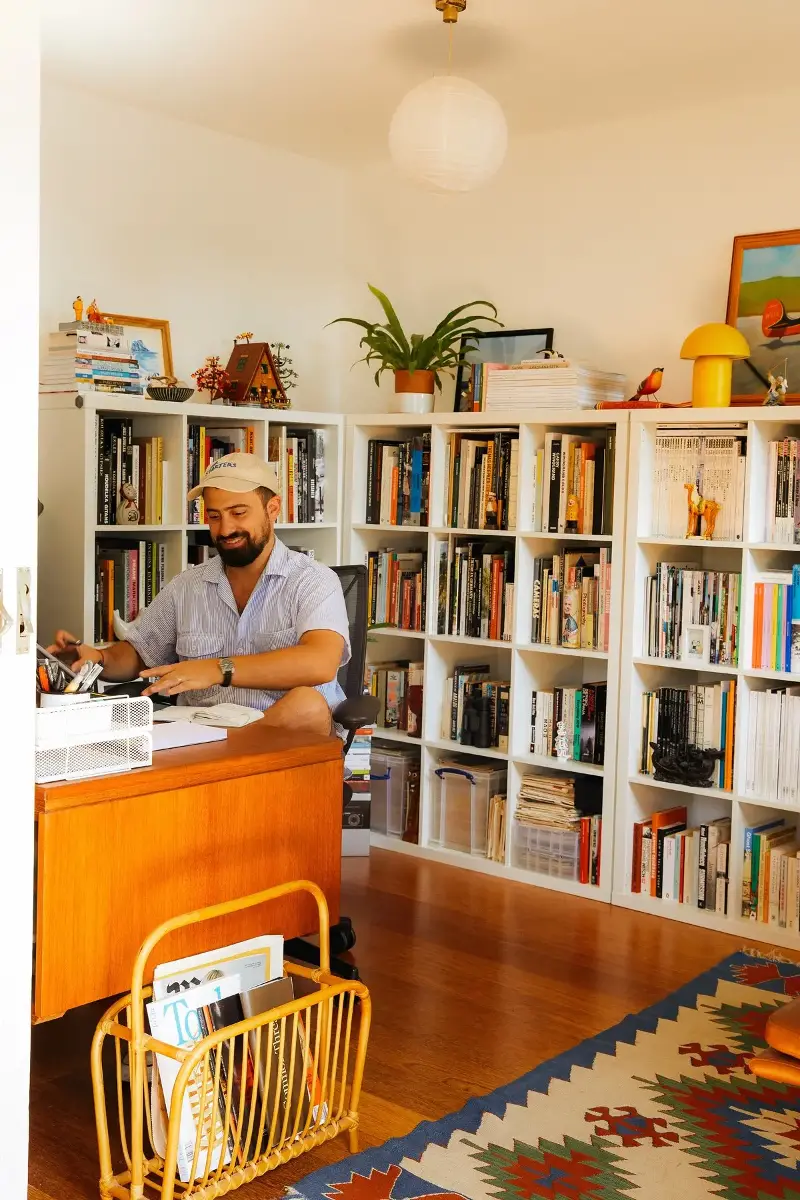
Renting at the Barbican is both a privilege and a constraint. Apartments cannot be altered beyond surface-level changes — yet this very limit only draws out the couple’s creativity. As soon as they entered their new home, the heavy curtains were taken down to flood the space with light. The door between the living area and Danny’s office was widened to create a greater sense of space, and the rooms were divided into zones for work and life. Now, a large Danish desk grounds Danny’s workdays, while solid bookshelves cradle his archive of books and magazines, collected over decades.
Objects have migrated with them: a coffee table from LA, a still life from the Rose Bowl, and a growing collection of santon figurines brought back from each visit to Kim’s family home in Provence. For Kim, these are not mere decorations but treasures that mark time and place, with imperfections left intact.
There are few things that warm a space like print. Books, magazines, photographs and other printed matter just have a way of making a space feel like home. Print travels lightly yet carries the weight of meaning and memory. Whether placed on a shelf, leaned casually against a wall or stacked on a coffee table, print in all its forms reflects who we are and where we’ve been. In the landscape of rented living, it becomes a sort of biography, chronicling the chapters of life.
Kim and Danny’s London home demonstrates this concept beautifully. Its shelves are an ever-growing archive of photography journals and paperbacks softened by years of re-reading.
The couple’s printed pieces have followed them from one city to the next, serving not just as references but as companions. Whether a vintage concert poster or a well-thumbed travel guide, each contains a small piece of the world the pair have passed through together.
The couple’s style resists neat categorisation; Danny gravitates towards muted Americana, Kim to colour. Together they have developed a style they call “chaotic light”, in which Native American weavings, South-east Asian textiles and Mexican ceramics are layered against the Barbican’s cool wood and white walls to create an exhibit of their shared lives.
Mornings begin with coffee and fresh air on the balcony, while strolls through the gardens or photography sessions along the highwalks create breaks throughout the day.
Kim lights candles and plays meditation music before deep work; Danny closes his laptop to cook or, just as often, to order comforting chicken and rice dishes from neighbourhood spots. These gestures give shape to the fleeting nature of rental life and transform the entire Barbican estate into a cocoon within the city.
Recently, entertaining has entered their home. In the early years of the pandemic, their Barbican apartment was a sanctuary; now, friends are invited to see another face of the estate, less familiar than that of its public cultural centre. Hosting adds a layer of meaning to the home, joining art and objects such as the Totoro plushie that presides over their sofa, a playful “landlord” among their treasures. It is in shared experiences and favourite objects, not in permanence, that Kim and Danny’s sense of home is realised.
© The Standard Ltd