



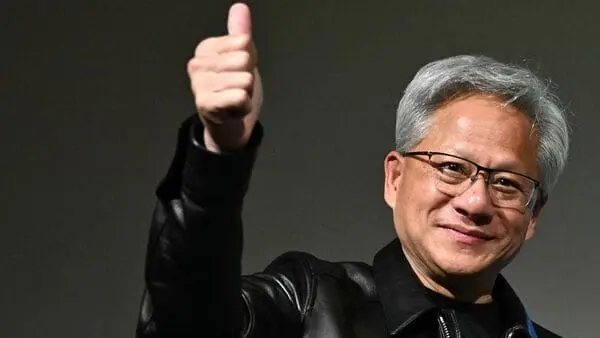
At most trillion-dollar tech titans, an engineer handing in their resignation is routed through a perfunctory exit interview with human resources. However, Nvidia Corp's Jensen Huang has an unconventional, hands-on management style that extends beyond the boardroom, Business Insider reported.
The billionaire co-founder counsels outgoing staff with a mix of blunt business critique, personal concern, and, in some cases, subsequent financial backing.
His unique style was evident in the case of David Hoeller and Nikita Rudin, key robotics and artificial intelligence engineers who left Nvidia in 2024.
The duo spent years working on robotics at the chip giant, pushing the boundaries of simulation and helping pull off a demo in which Huang took the stage with an ensemble of humanoids.
Hungry for the independence to deploy that intelligence in the real world, they left the chip company to prepare to launch their own startup, Flexion Robotics.
Dialling into a late-night call with their CEO from a tech conference in Munich, the duo braced for pushback. But Huang did not try to stop them; instead, he skewered their venture’s working title: Checkpoint.
“He told us that the name was bad, and that we had to change it,” Rudin told Business Insider, adding that they'd heard from others that the name sounded like it belonged in a different industry. “I don't want to give him all the credit, but we probably changed it because of his comment.”
They said that Huang followed it up with a reality check on the brutal mechanics of running a venture. “His message was, 'We don't realise how tough a journey it's going to be,'” Rudin said.
Flexion's example offers a glimpse into how Huang counsels his departing founders: with encouragement and little sugarcoating.
That directness extends throughout Nvidia's culture; Huang is famous for dismantling managerial hierarchies, roaming among project teams, and intervening directly in everything from granular code output to customer gripes.
The tough love paid dividends: the duo rebranded their startup as Flexion Robotics, set up shop in Zurich, and later secured backing from Nvidia itself. Now expanding into the US with a San Francisco outpost and recruits from Meta, Flexion has raised over $57 million.
‘Most honest feedback’
Bing Xu entered Nvidia in 2024 when the company bought his first startup. Earlier this year, he resolved to walk away from a potentially life-altering mountain of unvested Nvidia stock to launch INT21, an outfit that uses artificial intelligence to refine chip software.
According to Business Insider, when Xu broke the news, Huang pulled him and several senior Nvidia executives into a two-hour huddle. He tried to persuade him to stay, but when it became clear Xu’s mind was set, the CEO delivered a surgical critique of his leadership blind spots.
Huang told Xu that communication was his biggest professional liability—one that could throttle his ceiling as a founder.
Xu, the report said, had a habit of assuming everyone around the table possessed his niche technical depth, making his pitches dense and hard to track. Staying at Nvidia, Huang argued, would give him a safer crucible to master that skill.
"This is the most honest feedback I had in the past 10 years about myself," Xu told Business Insider, who now works with a public relations firm. “I didn't think my communication would be such a big problem, but when Jensen told me, I decided I could take this opportunity to become a better version of myself.”
The marathon confrontation, however, was not devoid of empathy, he noted.
Aware that Xu was battling high blood pressure and other personal health issues at the time, Huang urged him to hit pause, take time off, and recuperate before jumping into the startup grind.
For Xu, that mix of unsparing criticism and personal welfare confirmed what many who leave the Nvidia fold discover: the chief executive's bluntness is designed not to burn bridges, but to build better operators.