



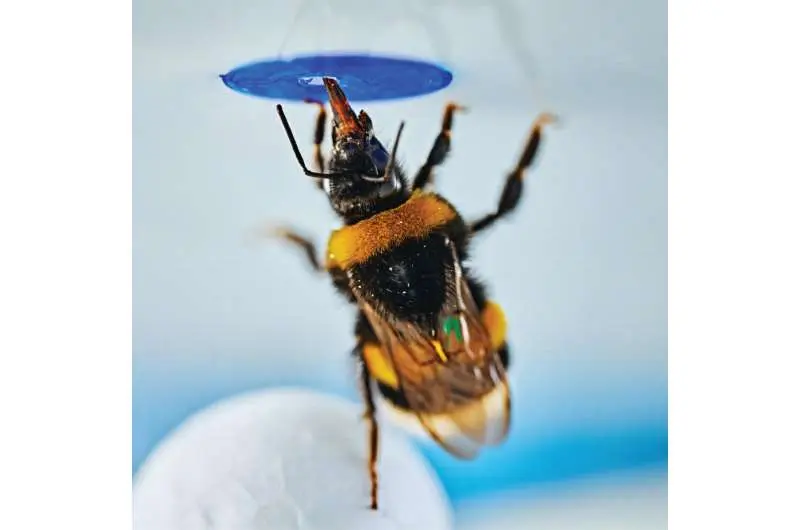
Bigger brains mean greater intelligence, or so conventional wisdom goes. After all, humans have much larger brains than most other animals and are generally considered the planet's most intelligent species.
But is brain size necessarily a measure of intelligence, or is it a myth ready to be busted?
Two neuroscientists from the U.K. and Sweden have been exploring this question, and they suggest that even creatures with tiny brains may be capable of surprisingly sophisticated thinking.
Their conclusions are based on studies involving bumblebees, whose brains contain fewer than a million neurons. That may sound like a lot, but in neurological terms, it's remarkably small.
Investigating insect intelligence
In a perspective published in Science, Lars Chittka of Queen Mary University of London and Stanley Heinze of Lund University reviewed previous research rather than conducting new experiments.
They examined findings from studies of bumblebee behavior alongside research into brain wiring maps of fruit flies. These show how individual nerve cells are connected. They also considered research on bee brains, although only a few regions have been mapped in detail so far.
Earlier research had revealed some sophisticated behaviors in bumblebees. These included moving a ball and climbing onto it to reach nectar in an enclosure with a ceiling too low for flight, and learning to solve complex puzzles by watching other bees.
But these experiments alone couldn't explain how such abilities arise in such small brains. This is where studies of the brain's wiring provided some clues.
Inside the bumblebee brain
Chittka and Heinze focused on two areas of the insect brain. The first is a region called the mushroom body, which plays an important role in learning and memory. It allows insects to associate things they see, smell or hear with positive or negative experiences.
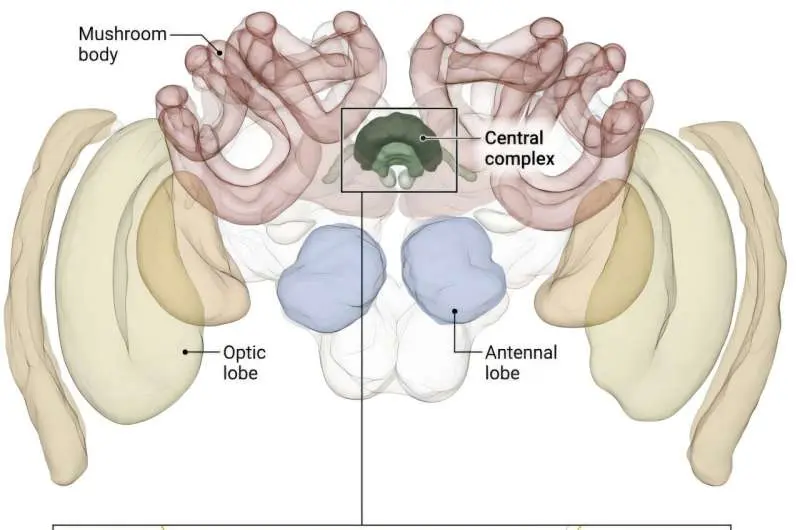
Although fruit flies have this region too, bumblebees possess around 50 times as many of the nerve cells involved in forming these memories. According to the authors, this means they have a greater capacity to store different memories without them interfering with one another.
The second region is called the central complex, which helps insects navigate and make decisions. Bumblebees have additional neural circuits in this region that may allow them to store information about several possible routes between food sources. The researchers suggest these circuits could also help bumblebees weigh different options and plan their actions.
So despite their tiny brains, bumblebees appear capable of remarkably intelligent behavior. And how these abilities evolved may be less complicated than previously thought, suggest Chittka and Heinze. "The remarkable cognitive abilities of bees may not have required them to evolve entirely new neural algorithms."
Written for you by our author Paul Arnold, edited by Gaby Clark, and fact-checked and reviewed by Robert Egan—this article is the result of careful human work. We rely on readers like you to keep independent science journalism alive. If this reporting matters to you, please consider a donation (especially monthly). You'll get an ad-free account as a thank-you.
Publication details
Lars Chittka et al., Bumble bee cognition, Science (2026). DOI: 10.1126/science.aek1724
Who's behind this story?

Paul Arnold
BSc Biology from University of London. BBC documentary producer with world travel experience. Freelances from southern Spain. Full profile →

Gaby Clark
MA in English, copy editor since 2021 with experience in higher education and health content. Dedicated to trustworthy science news. Full profile →

Robert Egan
Bachelor's in mathematical biology, Master's in creative writing. Well-traveled with unique perspectives on science and language. Full profile →
© 2026 Science X Network
Citation: Bumblebees challenge long-held beliefs about brain size and intelligence (2026, November 20) retrieved 20 November 2026 from https://phys.org/news/2026-11-bumblebees-held-beliefs-brain-size.html
This document is subject to copyright. Apart from any fair dealing for the purpose of private study or research, no part may be reproduced without the written permission. The content is provided for information purposes only.