



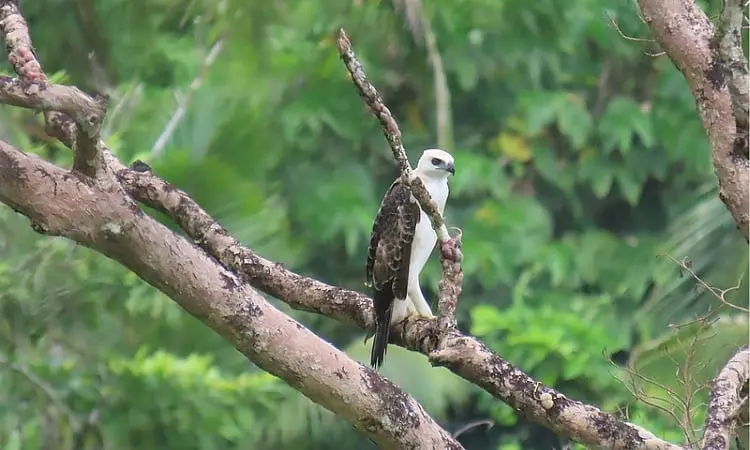
LOCAL conservation efforts are being strengthened to ensure the protection of the first documented active pair of South Philippine Hawk-Eagles (Nisaetus pinskeri), also known as Pinsker’s Hawk-Eagle, in Western Visayas.
Tristan Senarillos, a biologist at the Philippine Eagle Foundation (PEF), said that during their May 7, 2026 meeting, the Protected Area Management Board (PAMB) passed four resolutions for the conservation of the Hawk-Eagle family located just outside the Mahagnao Volcano Natural Park, in Burauen, Leyte.
The Pinsker’s Hawk-Eagle is listed as Endangered on the International Union for Conservation of Nature (IUCN) Red List due to its declining population, estimated at 1,300 to 3,600 mature individuals based on the latest data. The species is endemic only to Mindanao, Leyte, and Samar.
Senarillos said the resolution stipulates the protection of the nest site and prioritizes it for conservation since it lies outside the protected area. It also includes the species among the priority species for long-term monitoring and research.
He said another resolution focuses on capacity building for stakeholders and partners, particularly forest rangers and field staff, on how to monitor the species. The initiative aims to increase the number of individuals capable of conducting scientific research.
The last resolution involves a public naming ceremony wherein suggestions from the public will be collected for the juvenile eagle’s name, with the winning entry to be given to the eaglet.
Senarillos said one of the biggest threats to the species is the practice of kaingin, as the nesting site is located outside the protected area and sits on privately owned land that is actively farmed.
“Very important yung resolution to hopefully mitigate with the lawak ng farmlands to safe and protect the remaining farmlands (It’s very important that the resolution hopefully helps mitigate the widespread conversion/use of farmlands and safeguards and protects the remaining farmlands),” he said on May 18, 2026.
Senarillos said the Provincial Government of Leyte and the Municipal Government of Burauen have been proactive in ensuring the protection of the nesting pair.
For its part, the PEF plans to gradually expand its conservation efforts not only for the Philippine Eagle but also for other endangered raptors in the country.
Senarillos said they are beginning to expand conservation efforts to other raptors in the Philippines, starting with the South Philippine Hawk-Eagle. He added that some of the research methods being conducted on the Philippine Eagle are now being pilot-tested on the South Philippine Hawk-Eagle.
“It’s one of the most threatened raptors we have in the Philippines; despite its conservation importance, we know so little about it,” he said.
“This information is very important and crucial so that we can know how to help and know the concerns of the species,” he added, citing how the data they have gathered would help in crafting a species conservation plan for the South Philippine Hawk-Eagle.
Dr. Jayson Ibañez, PEF director for operations, said that through their pilot program on the South Philippine Hawk-Eagle in Leyte, they learned how to work with other raptors alongside the Philippine Eagle, despite not yet having dedicated funding or a separate program for the species.
“We hope to expand the effort to include the Philippine serpent eagle and other raptors in our research and advocacy work,” he said.
To further bolster the protection of the eagle, several signs were installed around the eagle’s territory. The signs state that an endangered bird is breeding in the area and advise the public to keep a safe distance from the nest, avoid making loud noises and sudden movements, and move through the area quickly and quietly.
“Human disturbance during the nesting season can cause parents to abandon their eggs or chicks, leading to nesting failure,” the sign reads.
The signs are written in English with translations in the local dialect. Senarillos said it is important for the notices to be translated into Waray so that communities near the nest site can better understand the importance of conservation.
Discovery of the eagle
The nest was discovered in November 2025 by biologists, DENR staff, and forest guards during the monitoring of the Philippine Eagle Lakpue. The group accidentally documented a pair of South Philippine Hawk-Eagles building their nest, marking the first active nest of the species documented in Western Visayas.
After verifying the active pair of eagles, the group revisited the nesting site in January 2026 and began daily observations on January 21, 2026, from morning until afternoon to document the pair’s behavior.
Senarillos said it took them 41 days of daily observations to record the pair’s incubation phase and the eventual hatching on March 2, 2026. He added that the juvenile South Philippine Hawk-Eagle is already 11 weeks old.
He shared that one of the notable behaviors observed in the juvenile eagle is its ability to perform “branching,” or transferring from the nest to different branches. The young raptor even made its maiden flight on May 17, 2026, covering approximately 15 meters from its nest.
The South Philippine Hawk-Eagle breeds yearly and produces only one egg every breeding season.
Although the nest was discovered outside the Mahagnao Volcano Natural Park, Senarillos said the local government remains active in supporting conservation efforts for the species.
To recall, a South Philippine Hawk-Eagle — earlier reported to be a common Philippine hawk-eagle or lawin — was rescued in Sitio Kilabot, Barangay Panansalan in Compostela, Davao de Oro, and successfully surrendered to the Municipal Environment and Natural Resources Office (Menro). The Pinsker’s hawk-eagle was found inside a chicken cage after reportedly eating two chicks on April 5, 2026.
In Davao City, these majestic and highly vocal birds of prey can often be seen up close at the Philippine Eagle Center (PEC) in Malagos, Baguio District.
PEF said that when an individual encounters a distressed eagle or raptor, the first thing they should do is secure the bird. They should remain calm, and if the bird appears weak and unable to fly, they should gently secure it using a cloth or towel to avoid injury to both the bird and the rescuer.
Second, the bird should be assessed from a distance to determine whether it has injuries or appears weak or exhausted. A temporary container — such as a kennel, clean crate, or covered chicken cage — should then be prepared. The container should be placed in a quiet, isolated area and covered with cloth to help keep the eagle calm.
Noise, crowds, and excessive handling should be avoided. Feeding the bird, giving water, or administering medication should also be avoided, and the eagle should be left undisturbed.
The foundation said proper authorities should be contacted immediately and advised the public to wait for instructions from trained wildlife responders.
Pinsker’s Hawk-Eagle and Philippine Eagle: The difference
The South Philippine Hawk-Eagle is an endangered raptor endemic to Mindanao and some parts of Visayas and is smaller than the Philippine Eagle. The Philippine Eagle also has a mane-like crest, while the Hawk-Eagle, depending on its age, only has three to four crest feathers.
Another distinct difference is that the legs of the Hawk-Eagle are covered with feathers, unlike the Philippine Eagle’s legs.
The eye color of a juvenile Hawk-Eagle is bluish-gray; however, it turns yellow as the bird matures, while the eye color of the Philippine Eagle remains blue until adulthood.
One similarity between the Philippine Eagle and the South Philippine Hawk-Eagle is that the juvenile Hawk-Eagle has a feather color palette similar to that of the Philippine Eagle. RGP