



Some years ago I visited the Isles of Scilly for the first time. I was on a sailing boat and we anchored off the uninhabited Eastern Isles. In the middle of the night I went out on deck. The sky was full of stars and the sea glowed with bioluminescence.
I felt we were in an enchanted, faraway place. Even the nearest island’s name, Nornour, sounded like something from the South Pacific. I vowed to return.
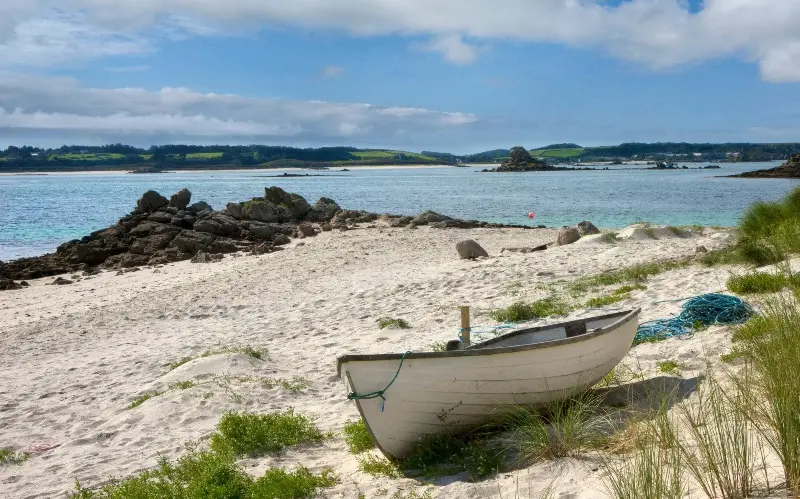
Finally, earlier this month, I went to the inhabited island nearest Nornour: St Martin’s. On that earlier visit I had swum along St Martin’s two-mile-long southern coast, entranced by its bright, almost-white, sandy beaches. Why it took me so long to return I don’t know.
Before we go much further, here is a brief background. There are five inhabited islands in the archipelago. The main one, St Mary’s, can be reached in under three hours from Penzance on the Scillonian III ferry, and is where most of the 2,000 locals live.
The others – St Agnes, Bryher, Tresco and St Martin’s – are tiny, both in landmass and population, and largely car-free. Transport between the islands is in small open boats.
Tresco attracts the well-heeled tourists. There are upmarket holiday homes and a direct helicopter service to the mainland. If you employ a nanny, have a couple of Labradors and wear expensive stripy T-shirts, this is the island for you. Islanders, and some tourists, revel in gently mocking Tresco.
Neighbouring St Martin’s is unlikely to be described as “a rich man’s playground” or “overly manicured”. It has decay and dereliction. There are dilapidated greenhouses, and an abandoned Land Rover covered with weeds – but even that is picturesque.
On St Martin’s, the locals, such as a whiskery old-timer Henry, who was sitting on a wall outside his house one morning when I met him, thought Tresco had become “money-mad”.
“They charge for everything, even to land on the island,” said the 78-year-old, with a look of disgust. “[Unlike Tresco], this island [St Martin’s] hasn’t changed much in my lifetime.”
Since Henry was a boy, the islands’ cut-flower trade has been slowly replaced by tourism. The one campsite on St Martin’s, with space for 100 people, celebrates its 70th anniversary this year.
Fields where daffodils once grew, sheltered from winds by tall hedges of pittosporum, make for perfect camping fields, especially when they’re right next to a soft, sandy beach.
No wonder the man in the tourism office on St Mary’s had described St Martin’s – his “favourite island” – as “a Famous Five-type place, unchanged since the 1950s”. (To be fair, a sense of a bygone era is evident the moment you arrive in the archipelago, 28 miles and a few decades from the mainland, not least with the honesty stalls selling flower bulbs, artwork and home-made jam).
The 140 inhabitants of St Martin’s appreciate that they live somewhere special, arguably the jewel in the crown of the archipelago. “I envy people who visit for the first time and see this island with fresh eyes,” said Jack Gillett, 29, whose parents own the St Martin’s campsite. “I’ve travelled the world for three years and I’ve seen lots of places, but nowhere as beautiful as this.”
Jack is a gardener. One of his customers is the only hotel, 30-bedroom Karma St Martin’s, adjacent to one of those perfect white beaches. The whole island feels like a garden. Exotic species thrive in the mild, frost-free climate, including aeonium growing out of granite walls, tall echiums and blue-and-white agapanthus.
While tourism is now ascendant, one flower farm on St Martin’s is still in business after more than 100 years. Churchtown Farm has flourished thanks to pioneering marketing. The farm began selling flowers through the post and had an online shop as early as the 1990s.
As I walked the mile of small road through the island, I passed an honesty stall with bunches of irises for sale. In the farm office, I met Zoe Julian, a co-owner, who told me how during the Second World War, Winston Churchill exempted the islands from the nation’s “dig for victory” food-growing campaign and allowed them to keep growing daffodils, “to boost morale”.
She also told me how the growth of tourism exacerbated the decline of the flower industry, already struggling because of cheap foreign imports. “What would you rather do: pick daffodils – back-breaking work in the wind in winter – or take tourists out on your boat in summer?” Zoe and her husband, Ben, are involved in both industries: agriculture and tourism. They have two holiday cottages.
I walked around the island in about three and a half hours, seeing no one for the first hour as I followed the coast on a peat-springy path between heather and gorse. Wrens trilled and wildflowers speckled the route with colour. The tide was out and I could have picked my way over rocks to White Island but forged on, admiring bays of white sand, edged with seaweed after a recent storm.
The red-and-white-striped daymark, a 17th-century daytime navigational aid on the northern cliffs, was a highlight of the hike, with views across the shallow waters between islands to the south and out to the Celtic Sea and the mainland to the north.
On the south coast, on a sandy path behind Marram grass dunes, I met a couple from Hull. Ann and Geoffrey Sheekey, in their late 70s, have been holidaying on the Isles of Scilly for six weeks annually since 1998, primarily to walk.
They stay three weeks on St Martin’s and three on St Mary’s, both of which they declared excellent for walking. As for the other islands: “Bryher and St Agnes are too small and Tresco is like Center Parcs,” was Geoffrey’s verdict.
A sandbar that is only visible at low tide was dazzlingly bright against the turquoise sea. It looked inviting after my round-island walk. I hired a kayak from a tattooed young woman on Par Beach and paddled out to the ephemeral landing spot where I hauled the kayak ashore and swam in crystal-clear but chilly water.
On my return, Anna Browne, the owner of St Martin’s Watersports, explained how the sea is so clear because of the lack of run-off – there being no rivers – and the big tides. “St Martin’s is perfect for kayaking as we’re near four uninhabited islands that can be explored,” she added.
From the beach, I walked to the island’s pub, The Seven Stones Inn. It has panoramic views from a flame-tree-shaded circular terrace, edged by a stone “hedge” (as they call drystone walls in these parts). The pub sells “shrub”, an old Cornish liqueur made by a pioneering young couple who own the island’s vineyard. Holly and James decided to relocate from Nottingham after their first holiday to St Martin’s in 2018. The island has that effect on people.
On my last night I visited the community observatory. Keen amateur astronomers manage two telescopes housed in white domes behind the Island Hall. On Tuesday nights you can visit and watch a presentation about the observatory that started life when a visiting astronomer commented on the exceptionally clear and dark skies.
Through the scope, I saw Jupiter and its four moons, but it was the tar-black sky full of stars that wowed me most as I walked back along the unlit, narrow road to the hotel afterwards. More stars than grains of sand on all the world’s beaches. Impossible to fathom.