



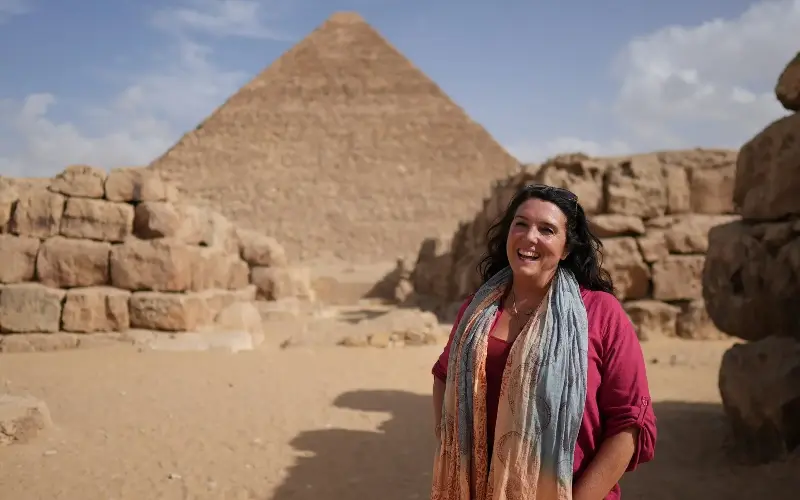
Professor Bettany Hughes is out of breath when she answers my call. “Sorry!” she puffs. “I’m on a Viking site in Uppsala, Sweden, so there may be some noises off… Would you like to see?”
The 59-year-old TV historian holds her phone camera aloft to offer a brief, sweeping view of a grassy burial mound before flipping it off again. I hear the stomp of her boots above the 1,500-year-old ashes of cremated Yngling dynasty elites as she explains that “one of the reasons” she’s filming there (for a yet-to-be titled programme) is to show audiences the “archaeological proof” that women wielded more power in Viking society than was once thought.
“We used to think it was just Viking men who were given warrior burials,” she enthuses. “But in 2017 Swedish geneticists posited that a skeleton buried at Birka [78 miles south-west of Uppsala] with a sword, two spearheads, an axe, arrows and two bridled horses was actually a woman and not a man, as had been assumed since the burial chamber was first excavated in the 1870s.”
Her camera may be off, but as a long-term fan I can fill in the visuals. For more than two decades I’ve lapped up Hughes’s cheerfully open-minded documentaries about ancient civilisations.
British audiences are accustomed to watching her scramble around the fallen pillars of ruined cities, up mountains, across deserts and deep into underground tombs (despite being scared of the dark and claustrophobic) in hit shows from Seven Wonders of the Ancient World to A Greek Odyssey. We’ve seen her pluck Roman pottery from the silt of the River Thames and dive for shipwrecks off the coast of Oman. Her presenting style is a mash up of Indiana Jones (swapping the hat’n’whip for her trademark selection of bright scarves) and bubbly tour guide.
Hughes knows what I mean. “Indiana Jones is obviously a very bad example of archaeological practice,” she laughs. “But those films definitely spurred me on to think: ‘Oh! There are people who actually do this. Adventure is a possibility.’”
This embrace of ancient appetites pours life into her dustier subjects. Watching her swig exotic liqueurs and run her hands over the curves of stone statues has helped make her a pin up for Gen Z and the LGTB community. My kids tell me that – along with the likes of Alison Hammond, Nigella Lawson and Jane McDonald – she’s acquired online “hun” status, a term of endearment typically given to older, female celebrities with a “camp” sense of humour. Is she aware?
“No!” She cringes. “I had no idea! I’m pocketing my blushes!”
But she’s actively reaching out to generations who might not watch TV by posting more on social media. “I’m really bad at it,” she says. “But we’ve posted clips from my fourth [Channel 4] series of Treasures of the World on TikTok that have reached two million views. It reminds you that there are people on those forums who really want to see these things.” Hughes’s social media push is a savvy one: there are more than one million videos under the hashtag #HistoryTok on the platform, where both professional and amateur historians share buzzy content about historic battles, monarchs and ancient civilisations.
And while TV’s other top classicist Mary Beard recently chided me for a tendency to “see the Romans as just like us in togas”, Hughes pushes for points of connection. She reaches back to Ancient Greece to make her case, reminding me that Socrates [the subject of her 2010 book The Hemlock Cup: Socrates, Athens and the Search for the Good Life] “was basically foreseeing us – and the troubles caused by an ill-judged online post – when he talked about the dangers of the written word being left free for interpretation without its parent to protect it. He really saw us coming.”
As a founding member of the charity Classics for All, which is dedicated to expanding access to Latin, Greek, and ancient civilisations beyond fee-paying independent schools, Hughes has long argued that studying the classics helps children boost literacy, wider language skills, critical thinking and deepens their understanding of politics. Only around 25 per cent of British state schools teach classics, compared to around 75 per cent of independent and private schools – leading to real social division.
The Labour government came under fire last year when it scrapped the Latin Excellence Programme, which promoted the teaching of the language in state schools, as part of wider budget cuts. Laura Trott, the shadow education secretary, said the decision was “vindictive from a Prime Minister who benefited himself from Latin [Sir Keir Starmer studied the language at Reigate Grammar School] and is now pulling up the drawbridge behind him”.
“The only reason a subject becomes elite is because it’s only taught in elite schools,” Hughes tells me. “50 per cent of the words we’re using in this conversation today are kind of Greco-Roman origin. Those languages are at the core of 32 modern European languages.” She sighs. “At one time farmer’s sons would all be taught Latin and had access to those cultures. It’s a shame that has slipped. It used to be much more accessible to everybody. We’re fighting to keep it out there so that everybody can benefit from it.”
Born in west London in 1967 – the daughter of “delightful” but impecunious actors who both left school at 14 and 16 – Hughes knows she is lucky to have grown up in a family that encouraged “the joy of knowledge”. She won scholarships at all levels of her own education; first to Notting Hill and Ealing High School, then to St Hilda’s College, Oxford (where she read Ancient and Modern History) and then on to a postgraduate History of Design programme at the V&A. She still lives in the same area she grew up in, with her husband, the theatrical producer Adrian Evans, and their two daughters.
Her passion for ancient history was sparked when her grandmother took her to see the blockbuster Tutankhamun exhibition at the British Museum in 1972, one month after her fifth birthday. Today she recalls the “absolute epiphany” of that excursion: “The realisation that all these stories I’d heard were true, that the proof is in front of me.”
Now, Tutankhamun has provided partial inspiration for Hughes’s latest children’s book. The Pharaoh’s collection of 129 walking sticks, with which he was buried, is one of the 20 artifacts featured in the delightfully vivid There Was An Egyptian In Your School.
Like its 2025 predecessor, There Was A Roman In Your Garden, the book is aimed at 7 to 12-year-olds and (like the author’s television programmes for adults) uses nuggets of antiquity as springboards for speculation about long-lost lifestyles.
Alongside sections on what the ancient Egyptians ate and what they believed in (so many gods and spells!) Hughes includes a section on a mysterious fragment of wood found in the Great Pyramid of Giza that is 500 years older than the pyramid itself. You’re giving the little archaeologists of the future a question to solve? “Yes! That’s it!” She says. “I also think it’s important for children to be aware that all treasures aren’t massive and blingy.”
Hughes admits she was recently annoyed that “somebody sniffy” had posted online slamming Treasure of the World as a series that focused only on items of huge monetary value. “We’ve featured things like a bit of old, silver birch – a kind of gum that was chewed by an Estonian teenager 10,000 years ago.”
She says she doesn’t mind online criticism “so long as people have watched the programmes first” and notes online sniping sits in sharp contrast with the warm welcome she reliably receives from locals on her travels. “It is incredible, when we’re somewhere remote, on the border of Azerbaijan or whatever, and people come up to say how pleased they are that we’re making these films. Lovely!”
This cheerful, can-do attitude is what helped her brush off the sexism she faced at the beginning of her career. She can now laugh as she recalls her first meeting with a BBC producer, in the 1990s: “He said, ‘Let me tell you three things: Nobody’s interested in history. Nobody watches history programs on television. Nobody wants to be lectured at by a woman.’”
She soon proved him wrong. In 2000 she became the first woman to present a history series on British TV (Breaking the Seal), and has since presented more than 50 shows for broadcasters including the BBC, Channel 4, Channel 5 and Netflix. But the challenges kept coming. She recalls an academic dismissing the topic of her 2005 bestseller, Helen of Troy: Goddess, Princess, Whore, as “fluffy”. Again, she had the last laugh when the book became a critical and commercial success.
As a writer, Hughes does worry that smartphones have stopped us reading as much as we once did. Last year, researchers at the University of Florida and University College London found that, in America, reading for pleasure had fallen by 40 per cent over the past two decades. Meanwhile, in Britain, the National Literacy Trust revealed that the number of children reading had dropped to its lowest level in two decades: of girls aged eight to 18, 39.1 per cent said they enjoyed reading in their free time, compared with just 25.7 per cent of boys.
“It’s a shame, isn’t it,” she sighs. “People talk about this problem of the shortening attention span and it’s only after you’ve really been focusing on the task for over 20 minutes that you create your brain physically creates new synaptic connections. You have to do that in order for your brain to be functioning healthily.” These days she says she “always takes a book with me on the Tube, just to remind the kids sitting opposite that this is a nourishing thing we can all do”.
And with that, Hughes has to dash off to explore some Viking ship burials and do some shopping. She is a sucker for souvenirs and praises her “long-suffering” husband for tolerating the clutter.
“Every surface of our house is covered in ancient rubbish that reminds me of my adventures!” she says. “My favourite is a giant ostrich egg, because Helen of Troy was said to be born from one. We know that in the Bronze Age they used ostrich eggs to transport beautiful perfumes. I like to imagine that if Helen had been real, she’d have had one of her dressing table.” She sighs. “My own egg is my connection to her.”
There Was an Egyptian in Your School is published by Penguin on July 16 at £8.99