



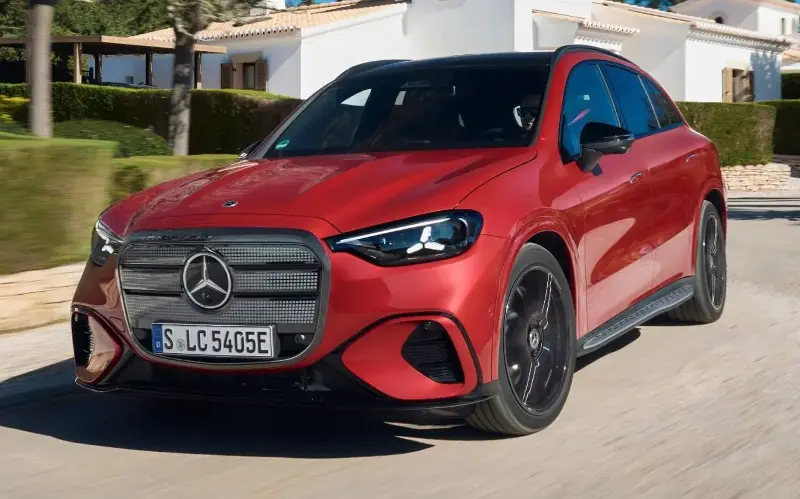
Perhaps it’s a nod to its illustrious past, but Mercedes-Benz has replaced the bland black panel at the front of its EQ series of electric vehicles (EVs) with facsimiles of distinctive grilles. I’m reminded of the W111/112 models of the 1960s, a marque high point, which helps make this good-looking new SUV that bit more approachable and less weird than its predecessor.
The electric version of the GLC, Mercedes’ most popular model, was launched in 2019 as the EQC. The platform was a bit of a lash-up, adapted from the standard GLC with additional strengthening struts and bars to support the weight of the batteries.
The new version has a dedicated EV-only platform with the same sort of technology revealed last year in the smaller CLA saloon, the reigning Car of the Year.
Under the skin
That means a twin-motor set-up with a 158bhp front motor allied to a more powerful rear motor featuring a two-speed planetary gearbox to keep it turning at its most efficient. The high-nickel-chemistry lithium-ion battery is mounted in the floor, while the drivetrain electronics are simplified and more efficient. Mercedes-Benz’s new operating system makes some things simpler and can be updated over the air quickly.
It also has (at least in the top models) the Hyperscreen, a full-width glass dashboard incorporating the main instrument binnacle, central touchscreen and a passenger screen. What does that give you? Well, more, but is “more” what customers want when a lot of that consists of avatars, games, films, links to restaurant reviews and a life where spur-of-the-moment choices can be made on destinations, hotels and restaurants?
This electric GLC is by no means a starter Merc, but with prices from £60,350 (some £6,000 more than the starter petrol-engined or diesel-engined GLC) this car will be driven by those on a semblance of a budget, whose on-the-whim restaurant choices are probably are more likely to be Nando’s or Pizza Express than The Ivy or the Fat Duck.
You can also choose from a range of background images, such as a campfire (as if you’d joined the Brownies) to an aquarium (as if you were in a dentist’s waiting room). Ain’t technology grand?
Inside job
It feels grand and spacious, with lots of space, although the driving seat feels as high-mounted as it is, because of the batteries in the floor.
You sit at the wheel with sun shining through the dimmable sunroof, looking across the glass fascia and down the longish bonnet. It induces a feeling that all is right with the world; I’ve done well in life, my reward is a Mercedes-Benz, and here I am.
At 4,845mm long, 2,089mm wide with mirrors and 1,644mm tall it’s quite a bit larger than the combustion-engined model (4,721mm, 2,076mm and 1,631mm). The wheelbase is 84mm longer, too, all the better to accommodate the 94kWh battery pack.
Depending on the specification and options, it weighs up to 2.7 tons, while the most basic mild hybrid petrol GLC is 1.84 tons.
The quoted range falls off slightly on the more expensive models with larger and wider tyres, but at best it’s 406 miles with an efficiency of 3.78 miles per kWh of battery power. At motorway speeds then across a long, winding pass I managed 3.03 miles per kWh, giving a theoretical range of 284 miles.
In the back there is a large amount of space for three passengers across the bench and the seats split 40-40-20 to give a flat load bed. The boot swallows 520 litres with the seat backs up, 1,690 litres with them folded and there’s a 128-litre under-bonnet storage area.
The oft-annoying alerts associated with the various Advanced Driver Assistance Systems (ADAS) are generally admirably muted: a light bar running underneath the windscreen and into the doors changes colour according to which function has something to nag you about.
On the road
Mercedes is majoring on comfort for this generation of the GLC, although the all-independent, air-sprung suspension of the test car is a £2,500 option in the UK.
Controlled and accommodating on lumpy roads it certainly is, but the softest setting allows so much body movement that it’s borderline floating while you can feel it shifting around on motorways.
The ride never quite settles, the rear heaves over the larger undulations and waddles over traffic-calming bumps if you don’t hit them square on. It’s an easy car to push beyond its comfort zone; if you do, your passengers will quickly become nauseous.
The Sport mode is an improvement, being firmer and more positive; however, the stodgy steering doesn’t alter much.
The brakes are nicely engineered, particularly the energy recuperation settings – which, combined with the long-travel accelerator pedal, allow accurate slowing into a corner without the on/off feeling of so many electric vehicles.
There’s plenty of urgency in the drivetrain and the GLC takes off like a scalded cat, or at least as fast as a 2.7-ton feline can manage.
The power delivery is well judged and you can moderate the accelerator to make the most of the range, although high speed, inclines and extremes of temperature will cause it to plummet.
The Telegraph verdict
For all its handsome looks and practicality, running an electric GLC will mainly appeal to those fortunate enough to have it in their choice of company car.
If the handling seems too soft, consider the ride quality on Britain’s appalling roads and you’ll perhaps think that Mercedes has judged it correctly.
I quite liked this car, although the UK-market passive suspension system might be preferable to the optional air set-up.
What it does, it does brilliantly, but the GLC feels as though it’s been engineered for a particular set of roads (American perhaps?) and an undemanding driving style.
The facts
On test: Mercedes-Benz GLC 400 4matic Premium
Body style: five-door electric SUV
On sale: now
How much? From £60,350 to £73,350 (as tested)
How fast? 130 miles per hour, 0-62 miles per hour in 4.3sec
How efficient? From 3.78 miles/kWh WLTP combined. 3.03 miles/kWh on test
Powertrain: 94kWh usable, lithium-ion NMC battery, twin motors (one front, one back) with two-speed transmission for the rear motor, four-wheel drive
Range: 406 miles maximum (WLTP), 231 miles on test
Charging: 11kW AC charger as standard 0-100 per cent in 10hrs; 7.4kW AC wallbox 0-100 per cent in 15.25hrs; 330kW DC 0-80 per cent in 22min
Maximum power/torque: 482bhp/590lb ft
CO2 emissions: 0g/km (tailpipe), 25.5g/km (CO2 equivalent well-to-wheel)
Vehicle Excise Duty (VED): £10 first year, £640 next five years, then £200
Warranty: three years/unlimited mileage, eight years/100,000 miles on battery
The rivals
BMW iX3 50 Drive M Sport, from £58,755
Smaller but more efficient, with a larger battery and a 500-mile range. This first neue klasse (a new era of BMW design and battery technology) offering employs its twin-motor set-up to assist the great handling, but the ride suffers on UK roads.
Tesla Model Y Performance 4x4, from £61,990
Recently mildly revamped and rapid, with 0-62mph in only 3.3sec, but feeling a bit dated inside. The ride and handling compromise isn’t as good as the new breed of German rivals, the iX3 and Mercedes CLA.