



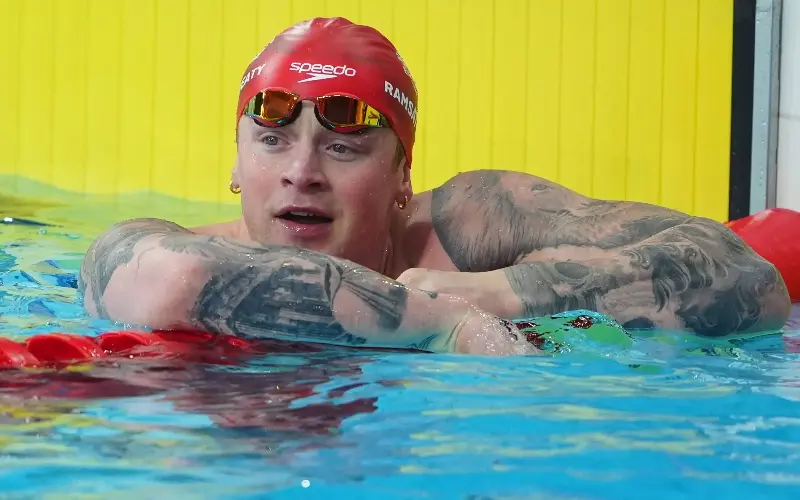
Adam Ramsay-Peaty will go into his 50 metres breaststroke final armed with a “battle plan” as he attempts to end his Commonwealth Games on a high.
Less than 24 hours after breaking down in tears after claiming bronze in the 100m breaststroke, Ramsay-Peaty returned to Tollcross Swimming Centre to qualify for Monday’s final over the shorter distance.
After breezing through his morning heat in 27.27sec, Ramsay-Peaty lowered his time further in his evening semi-final to qualify third-fastest in 26.82s.
“The last 24 hours have been a bit of a whirlwind, to be honest,” he said. “It’s not something I’m not used to. I guess in sport, it’s not really about when you get beat down because it’s going to be inevitable that you make mistakes, it’s actually about how long you take to look at it and put it into perspective and turn it around. I’m really happy with that. We’re on a great trajectory for tomorrow.”
Given he is still feeling his way back into the sport after taking a mental-health break in 2023, before claiming silver at the Paris Olympics in 2024 and then having another 20-month hiatus, Ramsay-Peaty’s lack of race sharpness at these Games is to be expected. South Africa’s Michael Houlie and Australia’s Sam Williamson – already crowned the 100m breaststroke champion in Glasgow – are the duo expected to battle it out for gold.
In order to help him through the rigours of a major competition, Ramsay-Peaty has found journaling a useful tool, while also relying on those closest to him. He has been cheered on in Glasgow by his influencer wife Holly, the daughter of celebrity chef Gordon Ramsay, whom he married earlier this year.
“There’s a lot of people I talk to, obviously my wife, my coach, my best mate Ed,” Ramsay-Peaty said. “Friends and team-mates. For me, the best way to ever get anything out of my head is to write it out. I write down what’s going wrong, what’s going right, what can I change, what can’t I change? Then I have a battle plan and [I say] ‘OK, I can work with this.’ So now I’m thinking what’s part of that battle plan? How can I use it for the final tomorrow?
“It’s always tense. I think just going through the rounds, really. Every time I race, I am getting that little bit stronger. I didn’t yesterday, which was unfortunate. People forget I haven’t done this for two years. I even forget that. To go through heats, semis, finals is quite difficult. I’m not used to it, which I’m not, even if in my whole career I’ve been used to it. From that perspective, it’s a good thing to handle and tomorrow I tell you what, I’m just going to enjoy the crowd.”
Ramsay-Peaty admits the next two years of his career will be the “hardest climb” as he chases a fourth Olympics. “It’s really hard to see the summit because it’s so hard,” he said. “I don’t think anyone understands.”
Filip Nowacki, the Jersey 18-year-old who won silver in the 100m breaststroke, qualified in sixth ahead of Scotland’s Archie Goodburn, 25, who has defied all odds to compete at these Games two years after being diagnosed with an incurable form of brain cancer.
Goodburn, who has lobbied Parliament for better treatment for brain-cancer patients, suffered a seizure before the Games trials, which put him in hospital for two days, but recovered in time to stand on the start blocks. He is currently taking a drug called Vorasidenib, which has halted the tumour’s growth.
Elsewhere in the swimming, England’s Alice Tai defended her title from four years ago in the women’s 100m backstroke S9 final, finishing 2.13 seconds faster than Australia’s Gemma Sellick.
Angharad Evans raised the roof at Tollcross Swimming Centre after triumphing in the women’s 100m breaststroke, on a fruitful day for the host nation, in which Reuben Ward won Scotland’s first gold medal in the men’s all-around gymnastics final.
However, the long absentee list continued to grow on the eve of the track-and-field action, after Louie Hinchliffe and Charlie Dobson, both 4x100m relay bronze medallists at the Paris Olympics, became the latest English athletes to withdraw from the Games.