



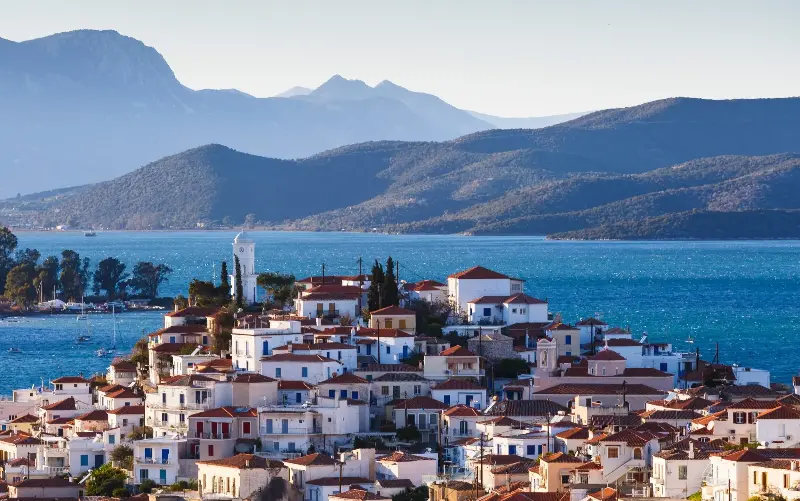
There is a particular look that travels across a group of friends when something doesn’t quite live up to the hype – not disappointment, exactly, but a cautious reassessment. We exchanged that look on Hydra. “This was really lovely,” someone eventually said, with the tentative air of a person about to commit mild heresy, “but, you know… I think I prefer Poros.”
Hydra has earned its reputation honestly. The car-free cobblestone streets, the 18th-century mansions built by wealthy merchants and shipowners, the donkeys carrying luggage up vertiginous lanes, the ghost of Leonard Cohen, who arrived at 25, bought a house and spent his formative years here writing poetry and setting it to music – all of it is as charming as advertised. We were glad to have walked, however briefly, in the footsteps of Sophia Loren, Melina Mercouri and Cohen. We also paid north of €13 (£11.30) for a Greek salad. Hydra knows exactly what it is, and prices accordingly.
Poros, by contrast, is more of an everyman island: still plenty of yachts moored up in the harbour (we did, naturally, look them up to see what they cost to rent), but none of the sense of being there to be seen, or because it has become a “thing”.
The island sits in the Saronic Gulf, around 36 miles south of Piraeus, separated from the Peloponnese by a channel so narrow – barely 200m across at its slimmest point – that the mainland feels less like another shore than a neighbouring street. It is, in fact, two islands rather than one: Sphaeria to the south, where the town sits on volcanic rock, and the larger, pine-forested Kalavria to the north, joined by a bridge over a narrow strait. The historic old town occupies one; the pine forests, ruins and beaches the other.
Poros wears its antiquity with admirable restraint. The island was sacred to Poseidon – mythology holds that Aethra, mother of Theseus, had her union with the sea god here – and the ruins of his 6th century BC temple are found in the island’s interior, a Doric structure that once served as the focal point of the Kalavrian League: a naval alliance of city-states, including Athens, Aegina and Nafplion, organised around this sanctuary as far back as the 7th century BC.
The temple’s most dramatic footnote came in 322 BC, when the orator Demosthenes, fleeing the Macedonian governor Antipatros after the failure of his final resistance, reportedly took hemlock here rather than submit to capture.
The island’s modern story is equally compelling. In 1827, during the Greek War of Independence, Poros became home to the first naval base of the newly emerging Greek state – and, shortly after, the country’s first naval academy. The Russian Bay on the island’s northern coast, with its golden sand and striking calm, takes its name from the Russian ships that docked here to support the revolutionary effort. The ruins of their shipyard remain on shore, declared a listed heritage monument, lending what might otherwise be simply a good beach an unexpected weight.
Poros Town is the kind of place that rewards slow walking. Built up a hillside – cascading whitewashed houses and narrow lanes that punish wheeled luggage but delight the eye – its most famous landmark is a pale blue clock tower from 1927, and the essential activity is the climb to reach it. The Archaeological Museum on Korizis Square, modest in scale but thoughtfully curated, houses findings from the Poseidon sanctuary and from ancient Troizen nearby – worth an hour of anyone’s time.
North of town, through the pine trees that give Kalavria its particular green, fragrant quality, the Sanctuary of Poseidon is more ruin than monument, but the setting is beautiful, and the historical charge of standing where Demosthenes made his final calculation titillating. The Holy Monastery of Zoodochos Pigi, founded in 1720 and built into a pine-forested hillside 2.5 miles east of town, offers cooler air, Byzantine frescoes and a working monastic community that has occupied this site for three centuries. For beaches, Russian Bay is a favourite. The smaller and more sheltered Love Bay offers strong competition, as does Monastiri Bay further along the coast.
Poros has not yet developed the kind of self-conscious restaurant culture that tends to follow fame. Taverna Karavolos is the place for Greek classics – moussaka and souvlaki are executed without fuss – with the more adventurous option of the house speciality: snails cooked with onions, garlic and tomato. The Old Platanus does courgette fritters and fava dip in the shade of – as its name might suggest – an old plane tree.
For something slightly more considered, Serenità Poros offers octopus with black tarama, ceviche of the daily catch and grilled meatballs with local anevato cheese – ambitious without being overwrought. Once it’s time for a sharpener, head to the courtyard at cocktail bar Floter for a moreish Salty Skin, made with mastic liqueur, lime, tonic, and salt and pepper, or catch the sunset from the roof terrace at Oceanis. A Greek salad, as noted, often runs to less than €10 (£8.70).
The practical argument for Poros is also pretty strong. The Hellenic Seaways Flying Cat from Piraeus reaches the island in 55 minutes – faster than to Hydra, which takes an hour and a half on the same service. If driving, you can take a car to Galatas on the Peloponnese coast and cross on the five-minute car ferry, making Poros unusually accessible for an island that still feels genuinely quiet. Hydra’s ban on cars and motorcycles is, of course, a large part of its charm – the quiet is real, and the absence of traffic genuinely transformative.
But charm and practicality do not always coincide. On Hydra, beaches are accessible only on foot or by water taxi, luggage travels by donkey, and anyone with children, limited mobility or simply a disinclination to hike in 35-degree heat will find that the constraints add up. On Poros, a local bus and the option to drive rather change the calculus – without, it should be said, making the island feel any less peaceful when you arrive.
None of this is to discourage a visit to Hydra. Go, by all means – walk in Cohen’s footsteps, say hello to the donkeys, visit the Hydra Book Club, a lovely curated bookshop dedicated to the island’s literary heritage. Just perhaps do as we did, and come here first. Arrive at Poros, let it quietly exceed your expectations, and you will find yourself sitting on a rooftop terrace at Oceanis as the sun drops behind the Peloponnese thinking: I wasn’t expecting this at all.
Essentials
EasyJet flies from London to Athens from £82 return. Boats from Piraeus to Poros run with Hellenic Seaways; the Flying Cat takes 55 minutes. Manessi Boutique Hotel has doubles from £78 per night, with breakfast.