



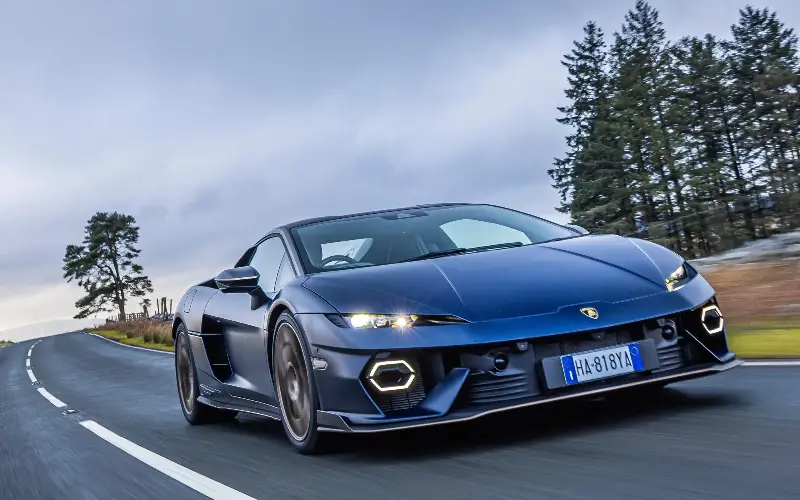
Since Ferruccio Lamborghini started making cars in 1963, his firm has become renowned for its extravagantly stylish, immaculately engineered machines. Legend has it that Lamborghini, an industrialist and customer of Ferrari, had become so exasperated with Enzo Ferrari’s parlous customer relations that he decided to build his own car, the 350 GT, employing some of Ferrari’s best engineers and designers who had become similarly short of patience with il Commendatore from nearby Maranello.
This new entry-level model is imbued with that traditional extravagance. Replacing the 5.2-litre, V10-engined Huracán, the Temerario has a 3,995cc, twin-turbocharged V8 combined with a plug-in hybrid (PHEV) drivetrain with three electric motors and a tiny lithium-ion battery.
These 4x4 PHEV systems are the choice of the supercar industry at the moment. The engine can have huge turbochargers, with the rear electric motor filling the gaps in performance and turbo lag. At the front, twin electric motors can drive or brake each wheel individually, aiding turn-in and stability – and also generating electricity via the braking system.
Under the skin
Much of its underpinnings comes from the V12 PHEV Revuelto, with a trio of 148bhp axial flux units, a 3.8kWh lithium-ion battery and four-wheel drive. The numbers are phenomenal: a top speed of 213mph and 0-62mph in 2.7sec. Fuel consumption is quoted at 25.2mpg, but you’d have to be exceptionally light-footed to achieve even 20mpg, while the electric-only range is a measly six miles.
The on-the-road price is £267,000, but the test car had a forest of extras which pushed the price to £416,945. Options apart, its price makes the Temerario something of a segment-buster, with cheaper rivals such as the McLaren Artura and the Ferrari 296 being V6-engined, with a single electric motor and rear-wheel drive. This aluminium alloy-shelled supercar is slightly larger than those, too. Up the scale is the Ferrari 849 Testarossa with a similar V8-based three-motor configuration and four-wheel drive, from £407,000.
Inside job
You have to pack light in a car such as this. An under-bonnet area offers room for a soft bag, but inside the storage provision is mean. The pedal box is tiny; those with large feet can find themselves pressing the brake and accelerator pedals at the same time.
By contrast, the interior feels wide, with lots of trim jutting and pushing aggressively at you. Unlike many Lamborghinis of the past, however, I can actually see out … well, let’s not get carried away. The flying buttresses either side of the engine cover partially obscure over-the-shoulder views, and you see a lot of engine air intake in the door mirrors, but views to the front and side are pretty good.
The central touchscreen is a vast improvement on the Huracán’s, but it’s still tricky to find lesser-used functions. And does your passenger really need their own screen to display, among other things, the speed and oil pressure (a £2,660 option)? More useful is the similarly priced nose lift to help negotiate raised kerbs and the like.
Fortunately a lot of buttons (including the nose lift) have migrated to the steering wheel, which with a little learning can be activated at will, although the braille-like audio controls out of sight behind the steering wheel spokes remain a mystery.
I can’t say it’s the most comfortable car. The fake suede, electrically powered and heated comfort seats (a £3,280 option) might be firm and accommodating, but they aren’t comfortable for long journeys.
Double wishbone independent suspension, with magnetorheological adjustable dampers, is standard along with 20in wheels at the front and 21in wheels at the rear.
Multiple modes
Myriad drive modes include four basic settings (Città, Strada, Sport and Corsa), three hybrid settings (EV, Hybrid and Performance) and another trio of choices in Drift mode.
With the Strada/Hybrid settings selected, I headed to the M1. This large, powerful car sets up a growling, whistling communication which never really goes away. The tyres roar and there’s a strange effect that the drivetrain drag feels more pronounced when you are pressing the accelerator than when you’ve lifted off. The exhaust note becomes more strident in Sport, and you need to raise your voice to converse.
It covers ground without effort, but the Temerario is not as other cars – it triggers emotions. Vans pass with phones hung out the windows to capture a snap. “Look at me,” the Temerario says, and folk seem more than happy to comply.
The ride isn’t exactly harsh, but at motorway speeds the wheels struggle with expansion joints and peeling blacktop edges, the tyres report like gunfire and the body shudders.
Turning off to the North Yorkshire moors, the car rolls with more compliance, and there’s a lovely stability and feeling of control as the Temerario tracks straight and true. The steering doesn’t kick back but has a fast ratio, and you need your wits about you, but there’s compliance in the suspension and it rides well.
Initially, you need to be aware of the width and weight. As you speed up, the impression of mass and bulk lessens. The steering has bite and accuracy, and the chassis feedback starts to stream back through the major controls. And the brakes are simply mind-blowing, powerful but with a sensitive and progressive feel. Push hard and you’ll wonder why your sunglasses are clattering off the windscreen.
Did I mention that it revs to 10,000rpm? While the V8 isn’t the best-sounding of engines, the cacophony as it nears the red line is emotive – not that you’ll be in that rev range for long at the rate the tarmac rushes under the nose. More pertinently, the mid-range torque and performance are addictive. The Temerario’s size and configuration mean it’s far from a grand tourer, but you can cover a lot of ground quickly and in relative comfort.
The Telegraph verdict
“You can always sell the million-pound special,” Lamborghini chairman, Stephan Winkelmann, once told me, “but it is more difficult to sell the same car week in, week out.” At the time that latter car was the Huracán; now, it’s the Temerario. And for some the absence of a boisterous, screaming V10 engine will be a source of sadness, but noise and emissions legislation have put paid to that – and this V8 PHEV fills the gap more than adequately.
What’s more, the calibration and refinement that Lamborghini’s engineers have put in have made the Temerario one of the best-driving cars out of Sant’Agata in many years. You’d need a racing circuit to approach its considerable potential, but even at a fraction of its capabilities on the road it’s an exhilarating drive and an amazing piece of four-wheeled theatre. And surely that’s mostly the point, isn’t it?
The facts
On test: Lamborghini Temerario
Body style: two-door, two-seat mid/rear-engined PHEV supercar
On sale: now
How much? from £267,000 OTR, £416,945 as tested
How fast? more than 213mph, 0-62mph in under 2.7sec
How economical? 25.2mpg (WLTP Combined)
EV range: 6 miles
Engine & gearbox: 3,995cc, 90-degree, twin-turbo V8 with 789bhp @ 9,000rpm and 538lb ft of torque, eight-speed dual-clutch gearbox, driving the rear wheels; three 148bhp axial-flux electric motors (one at the rear) and a 3.8kWh lithium-ion battery, two driving the front wheels
Maximum power/torque: 907bhp/538lb ft
CO2 emissions: 272g/km (WLTP Combined)
VED: £5,490 first year, £620 next five years, then £195
Warranty: four years/unlimited mileage
The rivals
Ferrari 296 Berlinetta, from £241,550
This 205mph, 818bhp Ferrari has a V6 engine and an electric motor driving the rear wheels only. So it’s lively, yet controllable and magnificent, if not as communicative as the McLaren.
McLaren Artura, from £202,660
A similar V6-and-electric-motor, rear-drive configuration. It had the stigma of a poor introduction, but since solving the issues, this has proved a delicious combination of balance, stability and power.