



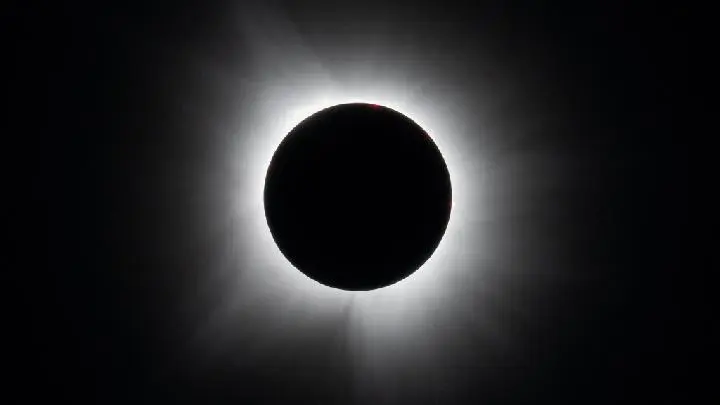
TEMPO.CO, Jakarta - Skywatchers around the world will soon have the chance to witness one of nature's most spectacular events: a total solar eclipse.
The celestial event will occur on August 12, 2026, but only people in a limited part of the world will be able to experience the moment when the Moon completely blocks the Sun.
According to NASA, the eclipse's path of totality will pass through Greenland, Iceland, parts of northern Russia, Spain, Portugal, and the Atlantic Ocean. Observers within this narrow path will see the Sun disappear behind the Moon for a brief period, creating a dramatic daytime darkness.
For those outside the path of totality, the eclipse will still be visible as a partial solar eclipse. Parts of North America, including several US states from Alaska to the East Coast, as well as regions across Canada, Europe, and northwestern Africa, will see only part of the Sun covered.
When Will the 2026 Total Solar Eclipse Happen?
The total solar eclipse is expected to take place on August 12, 2026, at around 11:34 a.m. Eastern Time (ET), according to Time and Date.
A total solar eclipse is relatively rare. On average, it occurs somewhere on Earth approximately once every 18 months, although the exact location varies each time. The last total solar eclipse visible from Earth occurred on April 8, 2024, crossing parts of North America.
Can the U.S. See the August 2026 Total Solar Eclipse?
No. Although the August 12, 2026 event is officially classified as a total solar eclipse, the United States will not be within the eclipse's path of totality.
Instead, observers in parts of the U.S. will only experience a partial solar eclipse, meaning the Moon will cover only a portion of the Sun. The eclipse is expected to make the Sun appear as if a "bite" has been taken out of it, with visibility varying by location.
The path of totality, where the Moon completely blocks the Sun and briefly turns day into twilight, will pass through Greenland, Iceland, parts of Spain and Portugal, northern Russia, and the Atlantic Ocean.
Which US Areas Can See the Partial Eclipse?
Although the US will not experience totality during the August 2026 eclipse, several states will be able to observe a partial solar eclipse.
The states expected to see the event include:
-
Alaska
-
Connecticut
-
Delaware
-
Illinois
-
Iowa
-
Indiana
-
Maine
-
Maryland
-
Massachusetts
-
Michigan
-
Minnesota
-
Montana
-
New Hampshire
-
New Jersey
-
New York
-
North Carolina
-
North Dakota
-
Ohio
-
Pennsylvania
-
Rhode Island
-
South Dakota
-
Vermont
-
Virginia
-
West Virginia
-
Wisconsin
The eclipse will appear different depending on the location, with some areas seeing a larger portion of the Sun covered than others.
Perseid Meteor Shower to Follow the Eclipse
The eclipse will be followed by another major skywatching opportunity.
The Perseid meteor shower, widely considered one of the best meteor showers of the year, will reach its peak shortly after the eclipse during a new moon phase.
The darker sky created by the absence of moonlight will provide better conditions for viewing meteors streaking across the night sky.
How to Watch the Solar Eclipse Safely
Looking directly at the Sun during a partial solar eclipse can permanently damage eyesight. Regular sunglasses are not enough to protect your eyes.
NASA recommends using certified eclipse glasses or handheld solar viewers that meet the ISO 12312-2 international safety standard.
Experts warn that consumers should be careful when purchasing eclipse glasses, as some products falsely claim to meet safety requirements. The American Astronomical Society recommends checking whether the viewers come from reliable manufacturers and have been tested by accredited laboratories.
During a partial eclipse, viewers should keep their protective glasses on at all times while looking at the Sun. The only time it is safe to look directly at the Sun without protection is during the brief period of totality, when the Sun is completely covered by the Moon.
For those outside the path of totality in 2026, the eclipse will still offer a rare opportunity to observe the Moon's movement across the Sun, as long as it is viewed safely.
Read: Three Meteor Showers to Light Up the Night Sky This July