



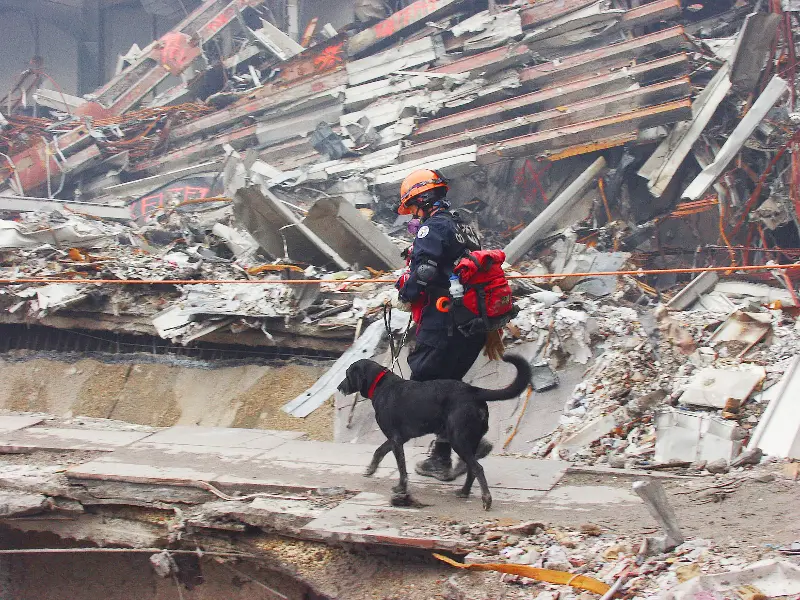
Twenty-five years ago this month, search-and-rescue dog teams deployed to the World Trade Center, the Pentagon and, eventually, the Staten Island landfill, where debris from the towers was taken.
Even with extensive training, the conditions were unlike anything these dogs had encountered before. They climbed unstable piles for hours at a time alongside firefighters, police officers and other responders. They worked with their noses close to the rubble, sniffing and panting as smoke, ash and fine dust filled the air. That material settled into their fur, eyes and noses. There was little between the dogs and that environment beyond their own natural defenses.
Veterinarian Cynthia Otto was there, caring for them. She left with a question that could not be answered in a month, a year, or even five years: What would happen to these dogs as they grew old? So, researchers did something increasingly difficult in science. They committed to waiting.
Otto enrolled 95 deployed search-and-rescue dogs in a study that would follow them for the rest of their lives, along with 55 search-and-rescue dogs that had not deployed to Sept. 11 sites. There were annual examinations, bloodwork, chest X-rays and, when handlers permitted it, tissue examination after death. The research continued until the last of the dogs was gone.
The AKC Canine Health Foundation, which I lead, funded that work across eight grants totaling more than $500,000. Much of that support came years after the television cameras had left and public attention had moved elsewhere. The study was designed to identify what might have gone wrong. Instead, the years revealed something far more encouraging.
Researchers did not find the feared wave of premature deaths among the dogs deployed to the Sept. 11 sites. They did not find higher cancer mortality or fatal respiratory disease. Their autopsies did reveal that particulate material could still be found in the lungs of some dogs years later, but its presence did not translate into the widespread disease researchers had feared.
In science, that is an important finding. It tells us something about the dogs of Sept. 11. But the study also hinted at something intriguing: Working dogs seemed to live longer than pet dogs of the same breeds. It did not prove that their work or lifestyle extended their lives, but it does invite us to look more closely at how these dogs lived.
Many of the things that characterized their lives are things we can give our own dogs—and perhaps even borrow for ourselves:
--Keep them lean. Maintaining a healthy body weight is one of the most practical things families can discuss with their veterinarian.
--Keep them moving. Exercise should suit a dog's age, breed and physical abilities, but aging does not have to mean becoming sedentary.
--Keep them thinking. A dog does not need to search a disaster site to have a job. Training, scent games, retrieving, puzzles or simply new experiences new can engage a dog's brain.
--Pay attention to changes. Working dog handlers know their partners exceptionally well. For the rest of us, changes in appetite, movement, sleep, behavior or enthusiasm can be early clues worth mentioning to a veterinarian.
--And maybe we should all borrow a little of their temperament. Search-and-rescue dogs are selected for qualities such as energy, the ability to learn, and low levels of fear and aggression. That may be a lesson for us humans, too: Stay curious, stretch ourselves to keep learning, meet the next challenge with enthusiasm, and don't waste too much of life being afraid of it. And keep doing things together.
Their story also teaches us something about what good science sometimes requires: time. We only know the story of their entire lives because researchers kept studying them—and someone kept funding the work—long enough to find out what happened.
We often demand speed from science. We want answers to the disease in front of us, and understandably so. But some of the questions that matter most cannot be answered quickly. What happens five years after an exposure? Ten? Which early changes predict disease that does not appear until much later?
To answer those questions, someone has to keep looking after everyone else even as everyone else has stopped watching. Someone must fund year eight, year 10, and year 14, knowing the most important answers may still be years away. That is what happened for the dogs of Sept. 11.
Twenty-five years later, perhaps their final job is still teaching us: A life is worth studying from beginning to end—and worth filling, for as many years as we are given, with movement, curiosity, care, a little fearlessness, and something to do beside someone we love.
____
Dr. Stephanie Montgomery is a veterinarian and chief executive officer of the American Kennel Club Canine Health Foundation, based in Raleigh, which funded the research described here.
Learn more about the research that is creating a world where dogs can lead healthier, more vibrant lives at akcchf.org.