


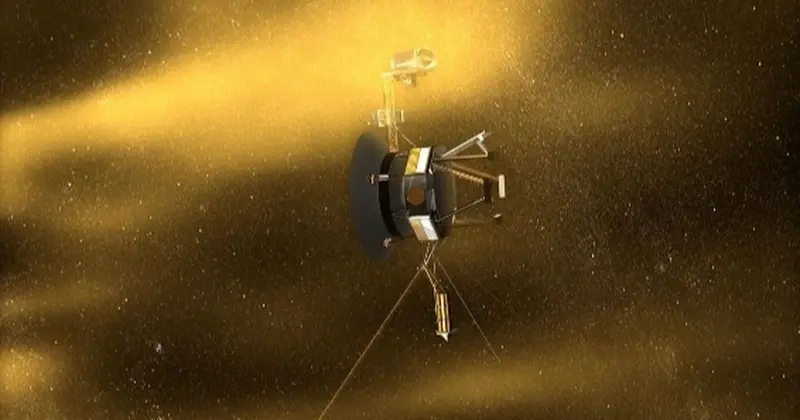

Illustration of one of NASA's two Voyager probes in interstellar space (Image: NASA/JPL-Caltech).
NASA's Voyager 1 spacecraft has just reached an unprecedented milestone in space exploration history: on November 18th, the spacecraft was approximately 25.9 billion kilometers from Earth, equivalent to the distance light travels in 24 hours, also known as a light-day.
This means that radio signals from Earth take approximately 24 hours to reach Voyager 1. The return signal from the spacecraft also takes a similar amount of time to return. Therefore, a two-way communication could last about two days.
Since the launch of Voyager 1 and its twin, Voyager 2, in 1977, the two probes have made significant surveys of the exoplanets of our Solar System.
Voyager 1 flew past Jupiter and Saturn, and also made a close approach to Saturn's moon Titan. Its orbit around Titan moved the spacecraft north of the ecliptic plane, preventing it from continuing its journey to Uranus and Neptune like Voyager 2.
Voyager 1 is currently the most distant man-made object from Earth. Meanwhile, Voyager 2 is expected to reach the one-light-day mark in November 2035.