



Google is extending its Android Automotive OS (AAOS) beyond infotainment systems, introducing a new platform aimed at powering the next generation of software-defined vehicles (SDVs).
The new initiative, called Android Automotive OS SDV, transforms the platform into a deeper, system-level operating foundation that can run multiple vehicle functions, not just entertainment and navigation (Android Auto).
Unlike the current version of AAOS, which is primarily used for in-car infotainment, the expanded platform is designed to support core vehicle components such as climate control, instrument clusters, lighting, cameras, mirrors, and telemetry systems.
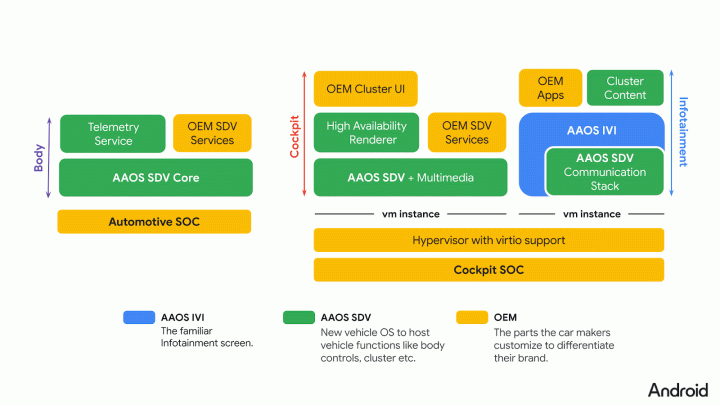
At its core, AAOS SDV is a lightweight, modular operating system built on Android, designed to address key challenges in modern vehicle development, including fragmented software systems and limited update flexibility. The platform introduces a service-oriented architecture that allows carmakers to deploy granular, over-the-air updates to individual vehicle functions.
Google is also emphasizing flexibility in deployment. The system can run using virtualization for separating software domains or directly on hardware for lower latency, depending on the use case.
To support development, AAOS SDV includes tools for cloud-based testing and simulation, allowing automakers to design and validate features before hardware is available. It also introduces a standardized signal catalog to reduce redundant engineering work across manufacturers and suppliers.
The platform is expected to be released to the Android Open Source Project (AOSP) later this year, opening it up to broader industry adoption.
Google has already partnered with Renault, which plans to use the platform in its upcoming Trafic e-Tech electric vehicle, set for production in late 2026. The company is also working with Qualcomm to scale deployment through Snapdragon-based automotive platforms.
With this move, Google is positioning Android Automotive OS as a full-stack platform for connected vehicles, reflecting the industry’s shift toward software-driven car architectures.